Expert Stove & Oven Repair in Gloucester, MA
Appliance Repair for Homes & Businesses in Gloucester, Ipswich, Essex, Rockport, Massachusetts and Nearby Areas
Stove and Oven Repair in Gloucester, Massachusetts | Appliance Repair Pros
Stove and Oven Repair in Gloucester, Massachusetts is essential for keeping your home kitchen functional and your family fed. The kitchen is the heart of the home and a broken cooking appliance brings meal preparation to a sudden halt. Instead of enjoying home cooked meals you are forced to rely on takeout or microwave dinners. You need a service partner who understands the urgency of a cold oven or a burner that refuses to light. Appliance Repair Pros provides expert diagnostics and repair for homeowners in Gloucester and the surrounding communities of Rockport, Essex, and Ipswich.
We encounter a wide variety of cooking appliance issues that disrupt your daily routine. You might find your gas oven takes too long to preheat or your electric range burners stay cold despite being turned to high. Perhaps the oven temperature is inconsistent leading to burnt cookies or undercooked roasts. In some cases the control panel flashes error codes or the door locks shut and refuses to open. We address these issues with meticulous diagnostics and respectful work habits. We treat your kitchen with care and focus on identifying the specific electrical or mechanical failure. Whether you are cooking on a vintage gas range in a historic home or a modern induction cooktop in a new condo we are ready to help.
Contact us today.
Stove and Oven Repair Services in Gloucester
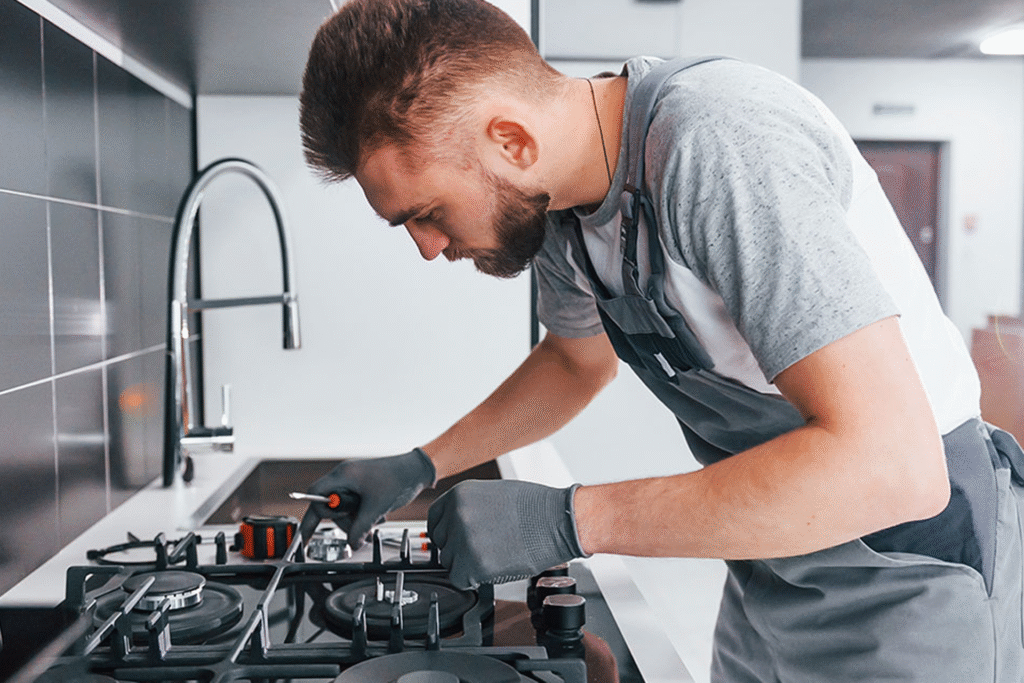
Our team offers a complete range of repair services for all major cooking appliance configurations. We understand that modern ovens and ranges combine traditional heating concepts with sophisticated electronics and safety systems. We do not just swap parts hoping for a fix. We analyze the ignition systems, airflow, and power regulation to ensure your unit cooks safely and evenly. Homeowners in Gloucester trust us to handle both gas and electric appliances with precision.
Oven and Stove systems we work on
- Gas ranges and freestanding stoves
- Electric ranges with coil or glass tops
- Built in wall ovens (single and double)
- Gas cooktops and rangetops
- Induction cooktops
- Dual fuel ranges
- Slide in units
- Convection ovens
What makes stove and oven repair tricky
- Glow bar igniters that must draw specific amperage
- Electronic spark modules with multiple outputs
- Safety valves that prevent gas flow without heat
- Infinite switches that regulate electric element cycling
- Hidden bake elements beneath the oven floor
- Convection fan motors and ring heaters
- Temperature sensors and calibration offsets
- Glass ceramic tops that require careful handling
Common Oven and Stove Problems We Fix
Cooking appliances show specific symptoms that point to underlying failures in the heating or control circuits. We have organized the most frequent issues we encounter to help you understand what might be happening with your range or wall oven.
Gas Oven Not Heating or Taking Too Long
A gas oven that fails to heat is one of the most common calls we receive. You may turn the oven on and hear the fan but the temperature never rises. Alternatively it might reach temperature eventually but take forty minutes to do so. This is usually not a gas supply issue but rather an ignition failure. Most modern gas ovens use a glow bar igniter that must get hot enough to open the safety gas valve.
Likely causes
- Weak or cracked glow bar igniter
- Defective safety gas valve
- Failed temperature sensor
- Broken wires in the ignition circuit
- Control board not sending voltage to the igniter
- Tripped thermal fuse on the back of the unit
How we diagnose it
We observe the igniter glow pattern. A healthy igniter glows bright white hot rapidly. If it glows dull orange or takes more than a minute to glow it is likely weak. We use an amp meter to measure the current flowing through the igniter. If the amperage is below a specific threshold the gas valve will not open even if the igniter looks hot. We also check the continuity of the safety valve to ensure it has not failed open.
What you can do right now
Check if the surface burners work. If they do you know you have gas to the unit. Look inside the oven while starting it to see if the igniter at the bottom glows at all.
Electric Oven Not Heating
Electric ovens rely on heavy duty heating elements to bake and broil. When these fail the oven becomes a storage box. You might notice the preheat indicator stays on forever or the food remains cold. In some cases the broil element works but the bake element does not resulting in uneven cooking.
Likely causes
- Burned out bake element (visible break or blister)
- Burned out broil element
- Loose or burnt wire connection at the element terminal
- Failed oven control board relay
- Tripped house circuit breaker (one leg of 240v lost)
- Blown thermal fuse
How we diagnose it
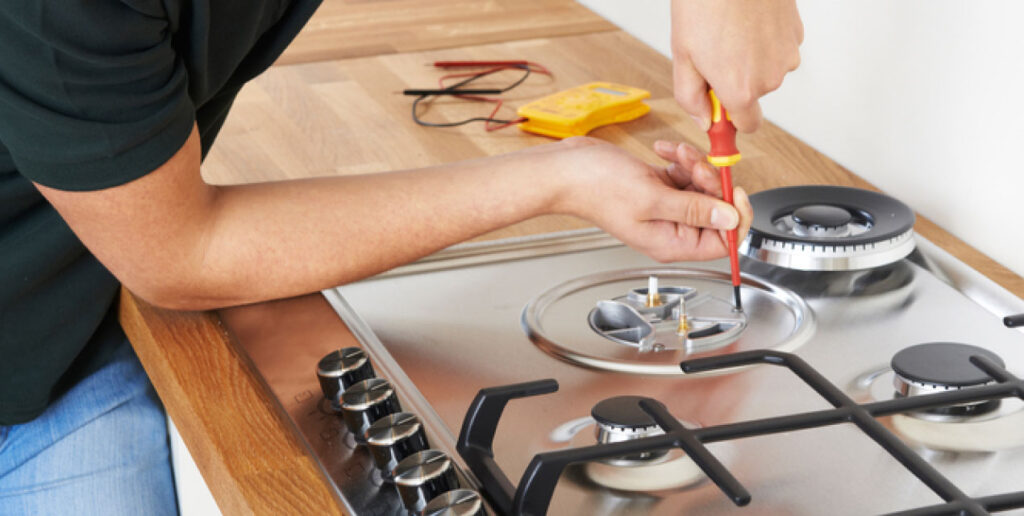
We start by verifying the voltage at the outlet. An electric range needs 240 volts to heat. If one of the two household breakers trips the lights might work but the heat will not. We inspect the heating element for physical damage. We use a multimeter to check the resistance of the element. If the element tests good we trace the voltage back to the control board to see if the relay is closing to send power.
What you can do right now
Check your electrical panel. Electric stoves use a double pole breaker. Turn it fully off and then back on to reset it. Look for visible breaks in the heating element inside the oven.
Surface Burner Not Lighting (Gas)
Gas burners that click but do not light are frustrating and can be dangerous if gas builds up. You might hear the clicking sound of the spark electrode but see no flame. Or you might hear no clicking at all when you turn the knob. This prevents you from boiling water or sautéing effectively.
Likely causes
- Clogged burner ports due to spills
- Cracked ceramic spark electrode
- Faulty spark module
- Defective burner switch harness
- Moisture in the burner assembly after cleaning
- Misaligned burner cap
How we diagnose it
We listen to the spark. If there is no sound we check the switch behind the knob. If we hear a spark but see no flame we check the gas flow and the alignment of the spark. Often the spark is jumping to the wrong spot due to a crack in the insulation. We inspect the tiny holes in the burner head to ensure grease is not blocking the gas flow.
What you can do right now
Remove the burner cap and head. Clean them with warm water and a toothbrush to remove debris. Ensure they are completely dry before reassembling. Check that the cap sits flat and is not wobbling.
Electric Surface Element Not Working
On an electric range a burner that stays cold usually indicates a break in the electrical path. This applies to both exposed coil elements and smooth glass cooktops. You might turn the knob and see the “On” light but feel no heat. This limits your cooking space and complicates meal timing.
Likely causes
- Burned out heating element or ribbon coil
- Failed infinite switch (the knob control)
- Burnt wire connection at the receptacle block
- Loose connection on the element prongs
- Broken limiter switch on a glass top element
How we diagnose it
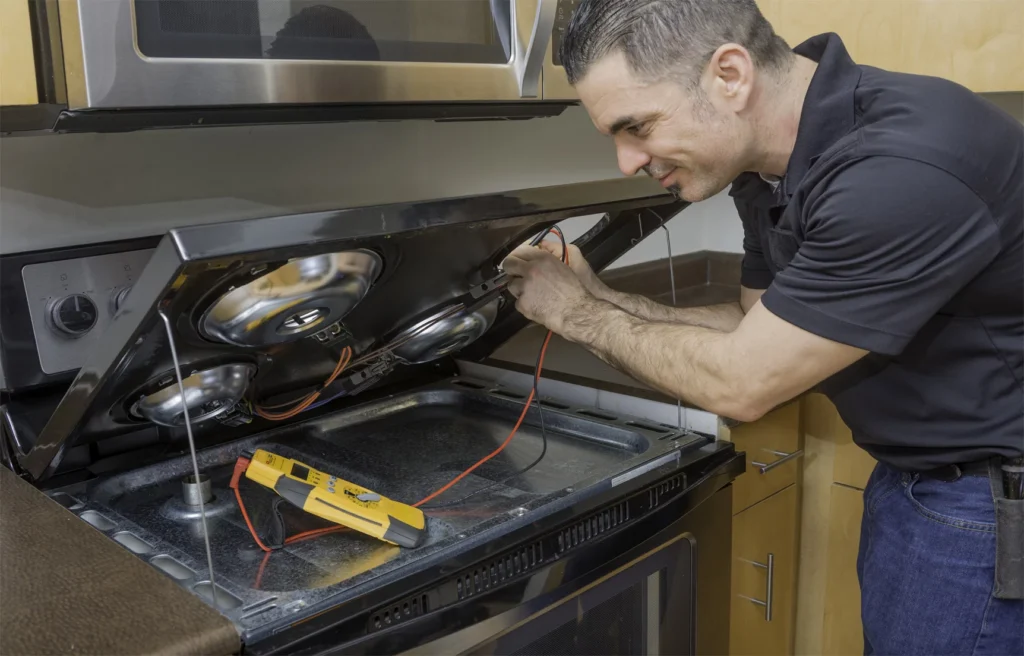
For coil tops we inspect the point where the element plugs into the stove. This receptacle often burns out due to arcing. We test the element for continuity. For glass tops we access the components beneath the glass and test the ribbon elements and the limiter which prevents the glass from overheating. We also test the switch to ensure it cycles power correctly.
What you can do right now
For coil tops wiggle the element gently to see if it is just loose. Inspect the prongs for black soot or pitting. Do not try to access components under a glass cooktop yourself.
Oven Temperature Is Inaccurate
If your recipes are consistently failing despite following instructions your oven temperature might be off. Cookies might burn on the bottom while the top is raw or a roast might take an hour longer than expected. While some variation is normal drastic swings indicate a problem.
Likely causes
- Drifting temperature sensor (thermocouple)
- Failing control board calibration
- Blocked airflow in the oven bottom
- Degraded door gasket letting heat escape
- Convection fan not circulating air
How we diagnose it
We use a professional digital thermometer to measure the actual temperature cycling inside the cavity. We compare this to the set point. We test the resistance of the temperature sensor which changes as it heats up. If the sensor is out of spec it sends false data to the computer. We also inspect the door seal for gaps that allow cold air to enter.
What you can do right now
Make sure you are not covering the bottom of the oven with aluminum foil as this blocks airflow. Check the door gasket for rips. Purchase an inexpensive oven thermometer to verify the variance.
Oven Door Stuck Shut or Won’t Open
A locked oven door often happens after a self clean cycle or a power surge. It traps your food inside or prevents you from using the appliance. The locking mechanism is a safety feature that can become a nuisance when it fails.
Likely causes
- Failed door lock motor assembly
- Misaligned door latch hook
- Control board stuck in self clean mode
- Warped door hinges
- Broken door sensor switch
How we diagnose it
We attempt to clear the error code by resetting power. If the door remains locked we manually access the latch assembly to release it safely. We then test the small motor that drives the lock and the microswitches that tell the board if the door is locked or unlocked. Replacing the lock assembly is often necessary to prevent it from jamming again.
What you can do right now
Turn off the circuit breaker for five minutes and then turn it back on. This sometimes resets the computer and causes the lock motor to retract. Do not force the door open as you will break the glass or the latch.
Uneven Baking or Hot Spots
Uneven baking turns a joy into a chore. You might find that the back left corner of a cake burns while the front right is doughy. This often points to airflow issues or a failure in one of the heating sources.
Likely causes
- Convection fan motor failure
- Bake element working but broil element dead (or vice versa)
- Oven rack positioned incorrectly
- Bent convection fan blade
- Thermostat cycling too slowly
How we diagnose it
We listen for the convection fan operation. We test both top and bottom elements to ensure they are both contributing heat. Modern ovens often cycle both elements even on “Bake” mode to balance the heat. If one is dead the heat distribution suffers. We also check the oven calibration.
What you can do right now
Ensure your cookware allows for airflow around the edges. Rotate your pans halfway through cooking. Check if the convection fan spins freely if visible.
Gas Smell When Using the Stove
Smelling gas is alarming. While a faint smell is normal when you first light a burner a persistent smell indicates a leak or unburned gas. This requires immediate attention for safety reasons.
Likely causes
- Igniter taking too long to light the gas
- Leak at the pressure regulator or gas line
- Burner valve not closing completely
- Spillover extinguishing a low flame
How we diagnose it
We use an electronic gas detector to find the source of the leak. We check the time it takes for the oven or burner to ignite. If ignition is delayed gas fills the cavity before igniting causing a smell and sometimes a “whoosh” sound. We inspect all internal gas connections.
What you can do right now
If the smell is strong turn off the gas supply and leave the house. If it is faint check that all knobs are in the off position. Ventilate the room.
Safety Notes for Stove and Oven Issues
Cooking appliances involve high heat, electricity, and often combustible gas. This combination creates specific safety risks that homeowners must respect. If you encounter dangerous symptoms please stop using the appliance and contact a professional.
If you smell gas (rotten eggs) do this first
- Extinguish any open flames or cigarettes immediately.
- Do not flip any light switches or use the phone near the appliance as a spark could ignite the gas.
- Turn off the main gas shut off valve if you can locate it safely.
- Open windows to ventilate the area.
- Evacuate the home and call your gas utility provider or emergency services from a safe distance.
If you see sparking or smoke do this first
- Turn off the burners or oven controls immediately.
- Go to your electrical panel and flip the circuit breaker labeled “Range” or “Stove” to the off position.
- Keep the oven door closed if there is a fire inside to starve it of oxygen.
- Do not throw water on a grease fire or an electrical fire.
Brands We Service for Stove and Oven Repair in Gloucester
Stoves and ovens vary significantly in their engineering. A high end French range operates differently than a standard American electric stove. Our technicians are trained on the specific mechanical and electronic designs of all major brands found in Gloucester kitchens.
Whirlpool family and similar designs (Whirlpool, Maytag, KitchenAid, Amana)
These brands are ubiquitous and generally reliable. They often use “Direct Spark” ignition in their newer gas ranges which eliminates the glow bar for faster lighting. Their electric ovens typically use a hidden bake element which protects the element from spills but makes replacement more involved.
Common issues we see with these models
- Spark module failure preventing ignition
- “DSI” error codes on the display
- Control board relays failing to close
- Keypad membranes peeling or shorting
- Self clean latch jams
We are experts at testing the Direct Spark Ignition boards found in Maytag and KitchenAid units to determine if the fault lies in the coil or the control logic.
GE family (GE, Hotpoint, and related lines)
GE ranges are known for their robust gas systems and specific glow bar igniter designs. They often use a series circuit for the safety valve meaning if the igniter is weak the valve physically cannot open. Their electric units often feature specific infinite switches for dual size burners.
Common issues we see with these models
- Weak glow bar igniters (very common)
- F7 error codes related to stuck buttons
- Safety valve failure
- Convection fan motors becoming noisy
- Glass top surface sensors failing
Diagnosis for GE gas ovens almost always starts with an amperage test of the igniter. We stock the high quality igniters these units require to operate reliably.
Samsung and LG
These South Korean brands have brought heavy computerization to the kitchen. Their ovens often feature twin fans, dividers to split the oven cavity, and complex user interfaces. They rely on multiple temperature sensors and logic boards to manage heat.
Common issues we see with these models
- Temperature sensor errors (SE or tE codes)
- Relay board failure causing runaway heat
- Convection fan heating element burnout
- Knob shafts breaking on gas ranges
- Touchscreen displays freezing
Because these units have multiple circuit boards we use the service manual diagnostics to isolate which board is at fault rather than guessing.
Frigidaire and Electrolux
Frigidaire ranges are popular for their simplicity and value but they have known weak points in the control board design. Their induction cooktops are efficient but require specialized knowledge to repair due to the high voltage generators involved.
Common issues we see with these models
- F1 error indicating a bad control board
- Surface element infinite switches burning out
- Oven probe socket failures
- Bake element terminals corroding
- Induction burner displaying “E” codes
We often see the “F1” code on these units which typically requires a board replacement or keypad repair. We can verify this quickly.
Bosch and Thermador
These premium brands offer high performance cooking with complex features like star shaped burners and simmer control cycles. Their gas ranges often use an electronic re-ignition system that will spark automatically if the flame blows out.
Common issues we see with these models
- Constant clicking of spark electrodes
- Simmer control module failure
- Door hinge tension loss
- Fan motor failures in wall ovens
- Display dimming or pixel loss
Repairing these units requires understanding the “flame rectification” process they use to sense heat. If the polarity of your outlet is reversed these stoves may not light.
Common Warning Signs and What They Usually Mean
Modern ovens often use codes to signal distress but sometimes the signs are physical. Here is what typical warning behaviors suggest about the health of your appliance.
- F0 or F1 Code: Usually points to a failed Electronic Range Control (ERC) or a stuck key on the touchpad.
- F3 or F4 Code: Often indicates an open or shorted temperature sensor circuit. The oven thinks it is 500 degrees when it is cold.
- F9 Code: Typically related to the door lock assembly. The oven cannot confirm the door is latched or unlatched.
- Constant Clicking: On a gas stove this means the spark module is energized. It can be a wet switch or a shorted wire.
- “Locked” Light Flashing: The door latch switch is not making contact or the motor is stuck in transit.
- Oven Light Won’t Turn Off: Usually a failed door plunger switch or a relay stuck on the control board.
- Burner Flame is Yellow: This indicates incomplete combustion. The air shutter needs adjustment or the port is dirty.
- “Hot Surface” Light Stays On: The limiter switch on the glass cooktop element contacts has welded shut.
Maintenance Tips for Stove and Oven Owners in Gloucester
Keeping your cooking appliances clean and maintained is the best way to ensure they last for years. Given the coastal environment of Gloucester and nearby areas humidity can sometimes affect electronic igniters so keeping them dry is helpful.
Keep the burner ports clean on gas ranges. These small holes distribute the gas. If they get clogged with spillover the flame will be uneven or fail to light. Use a needle or a small wire to clear them but be careful not to enlarge the holes. Avoid using abrasive pads on the ceramic spark electrodes as they can crack easily.
For glass cooktops wipe up sugary spills immediately. Sugar can pit the glass if it cools and hardens. Use a razor blade scraper designed for glass tops to remove burnt on food. Never use cast iron pans with rough bottoms on glass as they will scratch the surface.
Do not use the self clean feature right before a big holiday meal. The extreme heat of the self clean cycle (often over 900 degrees) puts immense stress on the components and is the number one cause of control board and latch failures. It is safer to clean manually or use the steam clean function if available. Also inspect the door gasket periodically. If it is torn heat escapes which wastes energy and can damage the knobs and control panel above the door.
Service Area for Stove and Oven Repair in and Around Gloucester, MA
We are a local business serving the North Shore community. We provide responsive service to homeowners across Cape Ann ensuring that you do not have to wait long for a working kitchen. We cover the entire peninsula and inland areas.
Nearby areas served
- Gloucester
- Rockport
- Essex
- Ipswich
Zip codes we serve
01930, 01931, 01966, 01929, 01938
Frequently Asked Questions
Is it cheaper to repair a gas stove or an electric one?
It varies by the problem rather than the fuel type. Gas stoves have more mechanical parts like igniters and valves while electric stoves have expensive control boards and large heating elements. Generally diagnostics costs are similar for both.
Why does my oven smell like gas when I turn it on?
A small puff of gas smell is normal as the valve opens before ignition. However if the smell is strong or persists it means the igniter is weak. The gas valve is open but the igniter is not hot enough to light it immediately allowing gas to accumulate.
Can I use my oven if the glass is cracked?
If the outer door glass is cracked it is a safety hazard but the oven will hold heat. If the inner door glass is cracked you should not use the oven as the heat will escape and dangerously overheat the outer door and handle.
Is the self clean cycle safe to use?
While convenient the high heat of self cleaning is a common cause of component failure especially in older ovens. It can blow thermal fuses and damage control boards. We recommend hand cleaning or using the feature sparingly.
Why is my convection fan making noise?
A noisy fan usually indicates that the bearing is worn out or the fan blade has become loose and is hitting the cover. This often happens after years of high heat cycles. Replacing the motor assembly solves the issue.
How do I know if my temperature sensor is bad?
If your food is consistently undercooked or burnt the sensor may have drifted. We can test its resistance with a meter. Sometimes the sensor is fine but the control board needs to be recalibrated which is a setting we can adjust.
Why does my induction cooktop hum?
A low hum or buzz is normal for induction cooking. It is the sound of the magnetic energy reacting with the cookware. However loud rattling might indicate a loose cooling fan inside the unit or incompatible cookware.
Can you repair vintage stoves in Gloucester?
We do service many older models provided that parts are still available. Simple mechanical thermostats and valves on vintage units are often repairable but some cosmetic parts for antique stoves may be obsolete.
Why does my electric burner only work on high?
This is a classic sign of a failed infinite switch. The internal contacts have fused together so the element gets full power regardless of the knob position. The switch needs to be replaced.
Is there reliable stove repair near me on the North Shore?
Yes we are locally based and service Gloucester, Rockport, Essex, and Ipswich specifically. We are familiar with the area and provide timely service to get your kitchen running again.
What causes a glass cooktop to crack?
Impact from dropping a heavy object is the most common cause. However thermal shock from placing a cold pot on a very hot burner or using a pan with a warped bottom that creates hot spots can also cause stress cracks.
Why is my gas flame lifting off the burner?
A lifting flame usually indicates too much air in the mixture or high gas pressure. It can also be caused by drafts in the room. We can adjust the air shutter on the burner tube to correct the flame profile.
Conclusion
Appliance Repair Pros is your dedicated partner for keeping your kitchen safe and functional. We offer professional stove and oven repair in Gloucester, Rockport, Essex, and Ipswich, handling everything from ignition failures to temperature inconsistencies. Our technicians use a safety first approach to diagnostics ensuring your gas or electric appliance is fixed correctly. Do not let a broken oven ruin your family dinner.
Reach out to us for assistance.